Shiva Lord of the Dance Is an Example of Art That?
| Nataraja | |
|---|---|
| Lord of the Dance | |
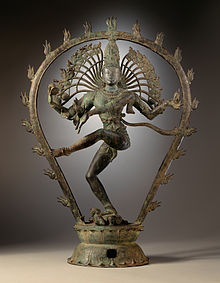 A tenth century Chola dynasty bronze sculpture of Shiva, the Lord of the Dance at the Los Angeles County Museum of Art | |
| Affiliation | Shiva |
| Symbols | Agni |
| Texts | Anshumadbhed agama Uttarakamika agama |
Nataraja (Sanskrit: नटराज, romanized: Naṭarāja ) (Tamil: நடராஜர்)[ane] is a depiction of the Hindu god Shiva as the divine cosmic dancer. His dance is called Tandava.[2] [three] The pose and artwork are described in many Hindu texts such every bit the Anshumadbhed agama and Uttarakamika agama, the trip the light fantastic toe murti featured in all major Hindu temples of Shaivism,[4] and is a well known sculptural symbol in India and popularly used as a symbol of Indian culture,[v] [6] in particular as one of the finest illustrations of Hindu art.[7] [viii]
The sculpture is symbolic of Shiva as the lord of dance and dramatic arts,[9] with its style and proportions made according to Hindu texts on arts.[10] Information technology typically shows Shiva dancing in i of the Natya Shastra poses, property diverse symbols[10] which vary with historic period and region,[2] [11] trampling upon a demon shown as a dwarf (Apasmara or Muyalaka[3]) who symbolizes spiritual ignorance.[10] [12]
The classical form of the delineation appears in stone reliefs, every bit at the Ellora Caves and the Badami Caves, by effectually the sixth century.[xiii] [14] Around the 10th century, information technology emerged in Tamil Nadu in its mature and best-known expression in Chola bronzes, of various heights typically less than four feet,[ten] some over.[15] Nataraja reliefs are establish in historic settings in many parts of South Eastern asia such every bit Angkor Wat and in Bali, Cambodia, and key Asia.[9] [16] [17]
Etymology [edit]
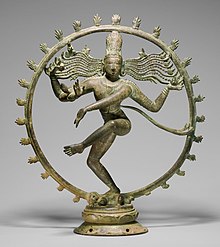
The discussion Nataraja is a Sanskrit term, from नट Nata meaning "act, drama, dance" and राज Raja meaning "king, lord"; it tin can exist roughly translated as Lord of dance or Male monarch of trip the light fantastic toe.[18] [19] Co-ordinate to Ananda Coomaraswamy, the proper name is related to Shiva's fame as the "Lord of Dancers" or "King of Actors".[20]
The form is known every bit Nataraja in Tamil Nadu and as Narteśvara (also written Nateshwar[21]) or Nṛityeśvara in North India, with all three terms pregnant "Lord of the trip the light fantastic toe".[22] Narteśvara stems from Nṛtta same as Nata which means "deed, drama, dance" and Ishvara pregnant "lord".[23] Natesa (IAST: Naṭeśa) is another alternate equivalent term for Nataraja plant in 1st-millennium sculptures and archeological sites beyond the Indian subcontinent.[24]
In Tamil, he is also known as "Sabesan" (Tamil: சபேசன்) which splits as "Sabayil aadum eesan" (Tamil: சபையில் ஆடும் ஈசன்) which ways "The Lord who dances on the dais". This form is present in most Shiva temples, and is the prime number deity in the Nataraja Temple at Chidambaram (Tillai).[25] The dance of Shiva in Chidambaram forms the motif for all the depictions of Shiva as Nataraja.
Depiction [edit]
The two almost mutual forms of Shiva's dance are the Lasya (the gentle form of dance), associated with the cosmos of the world, and the Ananda Tandava (dance of bliss, the vigorous class of dance), associated with the destruction of weary worldviews—weary perspectives and lifestyles. In essence, the Lasya and the Tandava are just two aspects of Shiva'southward nature; for he destroys in order to create, violent down to build again.[26]
According to Alice Blooper, the historic Nataraja artworks found in different parts of Republic of india are set in geometric patterns and along symmetric lines, particularly the satkona mandala (hexagram) that in the Indian tradition ways the interdependence and fusion of masculine and feminine principles.[27]
The sculpture is symbolic of Shiva as the lord of dance and dramatic arts,[9] with its manner and proportions fabricated co-ordinate to Hindu texts on arts.[10] It typically shows Shiva dancing in i of the Natya Shastra poses, holding Agni (burn down) in his left back paw, the forepart hand in gajahasta (elephant hand) or dandahasta (stick hand) mudra, the front correct manus with a wrapped snake that is in abhaya (fearfulness not) mudra while pointing to a Sutra text, and the dorsum manus holding a musical instrument, usually a Udukai (Tamil: உடுக்கை).[10] His body, fingers, ankles, neck, face, head, ear lobes and dress are shown decorated with symbolic items, which vary with historic period and region.[2] [28] He is surrounded by a ring of flames, standing on a lotus pedestal, lifting his left leg (or in rare cases, the right leg) and balancing / trampling upon a demon shown as a dwarf (Apasmara or Muyalaka[3]) who symbolizes spiritual ignorance.[x] [29] The dynamism of the energetic dance is depicted with the whirling hair which spread out in sparse strands as a fan behind his head.[30] [31] The details in the Nataraja artwork have been variously interpreted by Indian scholars since the 12th century for its symbolic meaning and theological essence.[15] [twenty] Nataraja is a well known sculptural symbol in India and popularly used as a symbol of Indian culture,[5] [32] in detail as one of the finest illustrations of Hindu fine art.[33] [34]
Symbolism [edit]
The symbolism has been interpreted in classical Indian texts such every bit Unmai Vilakkam, Mummani Kovai, Tirukuttu Darshana and Tiruvatavurar Puranam, dating from the 12th century CE (Chola empire) and later,[twenty] and include:[ten] [twenty] [35]
- He dances within a round or cyclically closed arch of flames (prabha mandala), which symbolically correspond the cosmic fire that in Hindu cosmology creates everything and consumes everything, in cyclic being or bicycle of life. The fire likewise represents the evils, dangers, heat, warmth, calorie-free and joys of daily life. The curvation of fire emerges from 2 makara (mythical water beasts) on each terminate.
- He looks calm, fifty-fifty through the continuous concatenation of creation and devastation that maintains the universe, that shows the supreme tranquility of the Atma.[36]
- His legs are aptitude, which suggests an energetic trip the light fantastic toe. His long, matted tresses, are shown to be loose and flight out in sparse strands during the dance, spread into a fan behind his head, because of the wildness and ecstasy of the trip the light fantastic.
- On his right side, meshed in with one of the flying strands of his hair near his forehead, is typically the river Ganges personified as a goddess, from the Hindu mythology where the danger of a mighty river is creatively tied to a at-home river for the regeneration of life.

- His headdress often features a human skull (symbol of bloodshed), a crescent moon and a flower identified as that of the entheogenic plant Datura metel.
- 4-armed figures are most typical, but ten-armed forms are also found from various places and periods, for case the Badami Caves and Ankor Wat.
- The upper right hand holds a small drum shaped like an hourglass that is called a ḍamaru in Sanskrit.[37] [38] A specific manus gesture (mudra) chosen ḍamaru-hasta (Sanskrit for " ḍamaru -paw") is used to hold the drum.[39] It symbolizes rhythm and fourth dimension.
- The upper left paw contains Agni or fire, which signifies forces of cosmos and destruction. The opposing concepts show the counterpoise nature of life.
- A cobra uncoils from his lower right forearm, while his palm shows the Abhaya mudra (meaning fearlessness in Sanskrit), suggesting not to fearfulness nearby evil, too as evil and ignorance surrounding the devotee equally he or she follows the righteousness of dharma.
- The lower left hand is bent downwards at the wrist with the palm facing inward, we likewise note that this arm crosses Naṭarāja'due south breast, concealing his heart from view. Information technology represents tirodhāna, which means "occlusion, concealment."
- The face shows two eyes plus a slightly open third on the forehead, which symbolize the triune in Shaivism. The eyes represent the sunday, the moon and the 3rd has been interpreted as the inner eye, or symbol of cognition (jnana), urging the viewer to seek the inner wisdom, cocky-realization. The iii eyes alternatively symbolize an equilibrium of the three Guṇas: Sattva, Rajas and Tamas.
- The dwarf upon whom Nataraja dances is the demon Apasmara purusha (Muyalaka, as he is known in Tamil), and who symbolises the demonic evil and ignorance over which the sacred dance of Shiva gives victory.
- The slightly smiling confront of Shiva represents his calmness despite being immersed in the contrasting forces of universe and his energetic dance.[15]
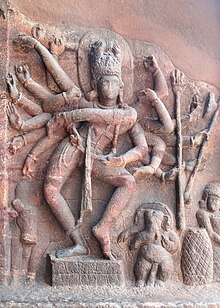
Padma Kaimal questions some of these interpretations past referring to a 10th-century text and Nataraja icons, suggesting that the Nataraja statue may have symbolized dissimilar things to different people or in different contexts, such as Shiva existence the lord of cremation or as an emblem of Chola dynasty.[40] In dissimilarity, Sharada Srinivasan questions the link to Chola, and has presented archaeological prove suggesting that Nataraja bronzes and dancing Shiva artwork in South Bharat was a Pallava innovation, tracing back to seventh to 9th-centuries, and its symbolism should exist pushed back by a few centuries.[41]
Meaning [edit]

Nataraja at Thanjavur Palace
Shiva's dance can be explained as:[42]
- First, information technology is seen every bit the image of his rhythmic or musical play which is the source of all motion inside the universe. This is represented past the circular or elliptical frame surrounding Shiva.
- Secondly, the purpose of his dance is to release the souls of all men from the snare of illusion.
- Lastly, the place of the dance, Chidambaram, which is portrayed every bit the centre of the universe, is actually within the heart.
Nataraja, states James Lochtefeld, symbolizes "the connectedness between religion and the arts", and it represents Shiva as the lord of dance, encompassing all "creation, destruction and all things in between".[43] The Nataraja iconography incorporates contrasting elements,[5] a fearless celebration of the joys of dance while beingness surrounded by burn, untouched by forces of ignorance and evil, signifying a spirituality that transcends all duality.[44] Furthermore, according to Carole and Pasquale, the deity non only tells of the eternal cycles of life (Jiva) from devastation to rebirth, simply also a human being should conquer the spiritual ignorance and thrill in self-realization.[36]
In the hymn of Manikkavacakar'south Thiruvasagam, he testifies that at Nataraja Temple, Chidambaram had, by the pre-Chola flow, an abstruse or 'cosmic' symbolism linked to five elements (Pancha Bhoota) including ether.[45] Nataraja is a significant visual interpretation of Brahman and a dance posture of Shiva. The details in the Nataraja artwork have attracted commentaries and secondary literature such as poems detailing its theological significance.[fifteen] [20] It is one of the widely studied and supreme illustrations of Hindu fine art from the medieval era.[46] [47]
Srinivasan notes that Nataraja is described as Satcitananda or "Being, Consciousness and Bliss" in the Shaiva Siddhanta text Kunchitangrim Bhaje, resembling the Advaita doctrine, or "abstract monism," of Adi Shankara, "which holds the private Self ( Jīvātman) and supream Self (Paramātmā) to be one," while "an earlier hymn to Nataraja by Manikkavachakar identifies him with the unitary supreme consciousness, by using Tamil word Or Unarve, rather than Sanskrit Chit." This may point to an "osmosis" of ideas in medieval Bharat.[48]
History [edit]
Rock reliefs depicting the classical grade of Nataraja are found in numerous cave temples of India, such every bit at the Ellora Caves (Maharashtra), the Elephanta Caves, and the Badami Caves (Karnataka), by around the sixth century.[13] [fourteen] One of the primeval known Nataraja artworks has been constitute in the archaeological site at Asanapat village in Odisha, which includes an inscription, and is dated to about the 6th century CE.[49] The Asanapat inscription likewise mentions a Shiva temple in the Saivacaryas kingdom.
Literary evidences shows that the bronze representation of Shiva's ananda-tandava appeared first in the Pallava period between 7th century and mid-9th centuries CE.[50] Nataraja was worshipped at Chidambaram during the Pallava catamenia with underlying philosophical concepts of catholic cycles of creation and devastation, which is also establish in Tamil saint Manikkavacakar's Thiruvasagam.[51]
Archaeological discoveries have yielded a carmine Nataraja sandstone statue, from 9th to 10th century from Ujjain, Madhya Pradesh, now held at the Gwalior Archaeological Museum.[52] [53] Similarly, Nataraja artwork has been found in archaeological sites in the Himalayan region such as Kashmir, albeit in with somewhat different dance pose and iconography, such as merely two arms or with eight artillery.[54]
Around the 10th century, it emerged in Tamil Nadu in its mature and best-known expression in Chola bronzes, of various heights typically less than four feet,[ten] some over.[fifteen] Nataraja reliefs are found in historic settings in many parts of S East Asia such as Ankor Wat, and in Bali, Cambodia, and primal Asia.[9] [55] [56] The oldest free-standing stone sculptures of Nataraja were built by Chola queen Sembiyan Mahadevi.[50] Nataraja gained special significance and became a symbol of royalty in Tamil Nadu. The dancing Shiva became a part of Chola era processions and religious festivals, a practice that continued thereafter.[57]
The depiction was informed of cosmic or metaphysical connotations is also argued on the footing of the testimony of the hymns of Tamil saints.[58]
In medieval era artworks and texts on dancing Shiva establish in Nepal, Assam and Bengal, he is sometimes shown every bit dancing on his vahana (fauna vehicle) Nandi, the bull; further, he is regionally known as Narteshvara.[59] Nataraja artwork accept besides been discovered in Gujarat, Kerala and Andhra Pradesh.[60]
In the contemporary Hindu civilisation of Bali in Republic of indonesia, Siwa (Shiva) Nataraja is the god who created dance.[61] Siwa and his dance as Nataraja was also historic in the art of Java Indonesia when Hinduism thrived there, while in Cambodia he was referred to equally Nrittesvara.[62]
CERN [edit]
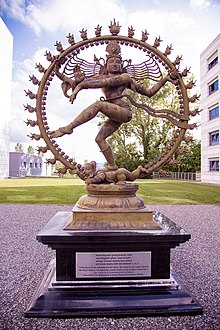
In 2004, a 2m statue of the dancing Shiva was unveiled at CERN, the European Heart for Research in Particle Physics in Geneva. The statue, symbolizing Shiva's cosmic dance of cosmos and devastation, was given to CERN past the Indian regime to gloat the research center's long association with Bharat.[63] A special plaque side by side to the Shiva statue explains the metaphor of Shiva's catholic trip the light fantastic with quotations from physicist Fritjof Capra:
Hundreds of years ago, Indian artists created visual images of dancing Shivas in a beautiful series of bronzes. In our time, physicists have used the most advanced technology to portray the patterns of the cosmic trip the light fantastic toe. The metaphor of the cosmic trip the light fantastic toe thus unifies ancient mythology, religious art and mod physics.[64]
Though named "Nataraja bronzes" in Western literature, the Chola Nataraja artworks are by and large in copper, and a few are in brass, typically bandage by the cire-perdue (lost-wax casting) process.[30]
Nataraja is celebrated in 108 poses of Bharatanatyam, with Sanskrit inscriptions from Natya Shastra, at the Nataraja temple in Chidambaram, Tamil Nadu, India.[2] [four]
According to Ian Crawford, professor of planetary science at University of London, the cosmic dance of Shiva as Nataraja represents particle physics, entropy and the dissolution of the universe.[65]
Gallery [edit]
-
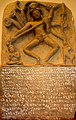
Asanpata Nataraj with Naga King Satrubhanja (261AD) Inscription at Keonjhar district of Odisha tertiary Century AD
-

sixth-century Nataraja in Cave 21, Ellora Caves[13]
-
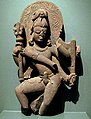
Ithyphallic 8th-century sandstone Nataraja from Madhya Pradesh
-

In the Shiva temple of Melakadambur is a rare Pala paradigm that shows the x-armed Nataraja dancing on his bull, Nandi
In dance and yoga [edit]
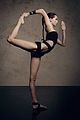
In modern yoga as exercise, Natarajasana is a posture resembling Nataraja and named for him in the 20th century.[68] A similar pose appears in the classical Indian dance form Bharatanatyam.[69]
References [edit]
- ^ Rajarajan, R. One thousand. Grand. "If this is Citambaram-Nataraja, then where is Tillai-Kūttaṉ? An Introspective Reading of Tēvāram Hymns". In Pedarapu Chenna Reddy, ed. History, Culture and Archaeological Studies Recent Trends, Commemoration Book to Prof. M.Fifty.1000. Murthy, Vol. II, Delhi: B.R. Publishing Corporation, Pp. 613-634, PLS. 54.1-6.
- ^ a b c d Archana Verma (2011). Performance and Civilisation: Narrative, Image and Enactment in Bharat. Cambridge Scholars Publishing. pp. 19–26. ISBN978-one-4438-2832-one.
- ^ a b c Encyclopædia Britannica (2015)
- ^ a b T. A. Gopinatha Rao (1997). Elements of Hindu Iconography. Motilal Banarsidass. pp. 223–224. ISBN978-81-208-0877-5.
- ^ a b c Gomathi Narayanan (1986), SHIVA NATARAJA Equally A SYMBOL OF PARADOX, Journal of Due south Asian Literature, Vol. 21, No. 2, pages 208-216
- ^ Anna Libera Dallapiccola (2007). Indian Fine art in Detail. Harvard University Press. p. 28. ISBN978-0-674-02691-nine.
- ^ David Smith (2003). The Trip the light fantastic of Siva: Religion, Art and Poetry in Southward Republic of india. Cambridge University Press. pp. i–2. ISBN978-0-521-52865-eight.
- ^ Frank Burch Brown (2014). The Oxford Handbook of Religion and Arts. Oxford University Press. pp. 489–490. ISBN978-0-19-517667-4.
- ^ a b c d Saroj Panthey (1987). Iconography of Śiva in Pahāṛī Paintings. Mittal Publications. pp. 59–60, 88. ISBN978-81-7099-016-1.
- ^ a b c d east f yard h i T. A. Gopinatha Rao (1997). Elements of Hindu Iconography. Motilal Banarsidass. pp. 223–229, 237. ISBN978-81-208-0877-5.
- ^ T. A. Gopinatha Rao (1997). Elements of Hindu Iconography. Motilal Banarsidass. pp. 236–238, 247–258. ISBN978-81-208-0877-5.
- ^ Shiva as Lord of the Trip the light fantastic toe (Nataraja), Chola menstruum, c. tenth/11th century The Art Institute of Chicago, Usa
- ^ a b c James C. Harle (1994). The Art and Architecture of the Indian Subcontinent . Yale Academy Press. p. 126. ISBN978-0-300-06217-5.
- ^ a b Archana Verma (2012). Temple Imagery from Early Mediaeval Peninsular Bharat. Ashgate Publishing. pp. 150–151. ISBN978-1-4094-3029-2.
- ^ a b c d due east James C. Harle (1994). The Fine art and Architecture of the Indian Subcontinent . Yale Academy Press. pp. 309–310. ISBN978-0-300-06217-five.
- ^ Banerjee, P. (1969). "A Siva Icon from Piandjikent". Artibus Asiae. 31 (1): 73–fourscore. doi:10.2307/3249451. JSTOR 3249451.
- ^ Mahadev Chakravarti (1986). The Concept of Rudra-Śiva Through the Ages. Motilal Banarsidass. p. 178 with footnotes. ISBN978-81-208-0053-3.
- ^ Coomaraswamy, Ananda K. (2013). The dance of Shiva. Rupa. p. 56. ISBN978-8129120908.
- ^ Stromer, Richard. "Shiva Nataraja: A Study in Myth, Iconography, and the Meaning of a Sacred Symbol" (PDF) . Retrieved ten March 2016.
- ^ a b c d eastward The Dance of Shiva, Ananda Coomaraswamy
- ^ "A journey to the past with dancing Shiva". The Daily Star. 27 September 2019. Retrieved 8 Nov 2020.
in an Old Dhaka temple ... a stone statue of Nateshwar, a depiction of dancing Shiva on the back of his bull-carrier Nandi
- ^ Los Angeles County Museum of Art; Pal, Pratapaditya (1986). Indian Sculpture: Circa 500 B.C.-A.D. 700 . University of California Press. pp. 34–36, 138. ISBN978-0520064775.
- ^ Brunner-Lachaux, Hélène; Goodall, Dominic; Padoux, André (2007). Mélanges Tantriques À la Mémoire D'Hélène Brunner. Institut français de Pondichéry. p. 245. ISBN978-2-85539-666-eight.
- ^ Stella Kramrisch (1981). Manifestations of Shiva. Philadelphia Museum of Art. pp. 43–45. ISBN0-87633-039-ane.
- ^ Ananda Kentish Coomaraswamy, The Dance of Siva: Fourteen Indian Essays, (New York, The Dominicus wise Plow, 1918), p. 58. Cyberspace Archive.
- ^ Carmel Berkson, Wendy Doniger, George Michell, Elephanta: The Cave of Shiva, (Princeton: Princeton University Printing, 1983). ISBN 0691040095
- ^ Alice Boner (1990). Principles of Limerick in Hindu Sculpture: Cave Temple Period. Motilal Banarsidass. pp. 163–164, 257. ISBN978-81-208-0705-one.
- ^ T. A. Gopinatha Rao (1997). Elements of Hindu Iconography. Motilal Banarsidass. pp. 236–238, 247–258. ISBN978-81-208-0877-5.
- ^ Shiva equally Lord of the Trip the light fantastic (Nataraja), Chola menses, c. 10th/11th century The Fine art Institute of Chicago, U.s.
- ^ a b Ananda Coomaraswamy (1922), Saiva Sculptures: Recent Acquisitions, Museum of Fine Arts Bulletin, Vol. 20, No. 118 (Apr., 1922), pages 18-19
- ^ Gomathi Narayanan (1986), SHIVA NATARAJA As A SYMBOL OF PARADOX, Journal of Southward Asian Literature, Vol. 21, No. 2, page 215
- ^ Anna Libera Dallapiccola (2007). Indian Art in Particular. Harvard University Press. p. 28. ISBN978-0-674-02691-9.
- ^ David Smith (2003). The Dance of Siva: Religion, Art and Poesy in South India. Cambridge University Press. pp. 1–2. ISBN978-0-521-52865-viii.
- ^ Frank Burch Brown (2014). The Oxford Handbook of Faith and Arts. Oxford University Press. pp. 489–490. ISBN978-0-19-517667-4.
- ^ Shiva Nataraja, lord of the dance Encyclopedia of Aboriginal History (2013)
- ^ a b DeVito, Carole; DeVito, Pasquale (1994). India - Mahabharata. Fulbright-Hays Summer Seminar Abroad 1994 (Republic of india). United states of america Educational Foundation in India. p. 5.
- ^ Alice Blooper; Sadāśiva Rath Śarmā (1966). Silpa Prakasa Medieval Orissan Sanskrit Text on Temple Architecture. Brill Annal. pp. xxxvi, 144.
- ^ For the damaru drum as one of the attributes of Shiva in his dancing representation meet: Jansen, page 44.
- ^ Jansen, folio 25.
- ^ Padma Kaimal (1999), Shiva Nataraja: Shifting Meanings of an Icon, The Art Bulletin Volume 81, Consequence 3, pages 390-419
- ^ Srinivasan 2004, pp. 432–450.
- ^ Ananda Kentish Coomaraswamy, The Dance of Śiva: Fourteen Indian Essays New York, The Sun wise Turn (1918), p. 58. Internet Archive.
- ^ James G. Lochtefeld (2002). The Illustrated Encyclopedia of Hinduism: A-M. The Rosen Publishing Group. pp. 147, entry for Chidambaram. ISBN978-0-8239-3179-viii.
- ^ James G. Lochtefeld (2002). The Illustrated Encyclopedia of Hinduism: N-Z . The Rosen Publishing Grouping. pp. 464–466. ISBN978-0-8239-3180-4.
- ^ Srinivasan 2004, p. 446.
- ^ David Smith (2003). The Dance of Siva: Organized religion, Art and Poetry in Due south India. Cambridge University Press. pp. one–4. ISBN978-0-521-52865-eight.
- ^ Roy C. Chicken (1976). A curtailed history of Indian art. Praeger. pp. 144–147, 160–161. ISBN978-0-275-22950-4.
- ^ Srinivasan 2004, pp. 447.
- ^ Rupendra Chattopadhya et al (2013), The Kingdom of the Saivacaryas, Berlin Indological Studies, book 21, page 200; Archive [ dead link ]
- ^ a b Singh, Upinder (2008). A History of Ancient and Early Medieval India: From the Stone Age to the 12th Century. Pearson Pedagogy Bharat. p. 642. ISBN9788131711200.
- ^ Srinivasan 2004, pp. 444–445.
- ^ 山本, 智教 (1971). "Catalogue of Antiquities from East asia in the Museums of fine art in U. S. A. Europe and Republic of india (v)". 密教文化. 1971. doi:x.11168/jeb1947.1971.96_L74.
- ^ James C. Harle (1994). The Fine art and Compages of the Indian Subcontinent . Yale University Press. pp. 156–157. ISBN978-0-300-06217-five.
- ^ Anne-Marie Gaston (1982). Śiva in dance, myth, and iconography. Oxford University Press. pp. 56, 47, 101. ISBN9780195613544.
- ^ Banerjee, P. (1969). "A Siva Icon from Piandjikent". Artibus Asiae. 31 (ane): 73–80. doi:10.2307/3249451. JSTOR 3249451.
- ^ Mahadev Chakravarti (1986). The Concept of Rudra-Śiva Through the Ages. Motilal Banarsidass. p. 178 with footnotes. ISBN978-81-208-0053-iii.
- ^ Aghoraśivācārya; Richard H. Davis (2010). A Priest's Guide for the Bang-up Festival. Oxford Academy Printing. pp. fifteen–20, 24–25. ISBN978-0-19-537852-8.
- ^ Sharada Srinivasan, "Shiva equally 'cosmic dancer': on Pallava origins for the Nataraja bronze", Globe Archaeology (2004) 36(3), pages 432–450.
- ^ Anne-Marie Gaston (1982). Śiva in dance, myth, and iconography. Oxford University Printing. pp. 130, 57. ISBN9780195613544.
- ^ Anne-Marie Gaston (1982). Śiva in trip the light fantastic, myth, and iconography. Oxford University Press. pp. 48–l. ISBN9780195613544.
- ^ Fredrik Eugene DeBoer; I Made Bandem (1995). Balinese Dance in Transition: Kaja and Kelod. Oxford University Press. pp. ii–3. ISBN978-967-65-3071-4.
- ^ Alessandra Iyer (1998). Prambanan: Sculpture and Trip the light fantastic in Aboriginal Java : a Study in Trip the light fantastic toe Iconography. White Lotus. pp. 69–seventy. ISBN978-974-8434-12-iv.
- ^ "Faces and Places (page 3)". CERN Courier. Archived from the original on 6 June 2018. Retrieved 30 January 2017.
- ^ "Shiva's Catholic Dance at CERN | Fritjof Capra". fritjofcapra.net . Retrieved 30 January 2017.
- ^ Ian Crawford (December 2019). "Expanding worldviews: catholic perspectives". Astronomy & Geophysics. Majestic Astronomical Gild, Oxford University Press. threescore (6): 6.38. doi:10.1093/astrogeo/atz195.
- ^ James C. Harle (1994). The Art and Architecture of the Indian Subcontinent . Yale University Press. p. 123. ISBN978-0-300-06217-five.
- ^ British Museum Collection
- ^ Iyengar, B. K. S. (1979) [1966]. Light on Yoga: Yoga Dipika. Thorsons. pp. 419–422. ISBN978-1855381667.
- ^ Bhavanani, Ananda Balayogi; Bhavanani, Devasena (2001). "BHARATANATYAM AND YOGA". Archived from the original on 23 October 2006. Retrieved 26 January 2019.
He also points out that these [Bharatanatyam trip the light fantastic toe] stances are very similar to Yoga Asanas, and in the Gopuram walls at Chidambaram, at to the lowest degree twenty different classical Yoga Asanas are depicted by the dancers, including Dhanurasana, Chakrasana, Vrikshasana, Natarajasana, Trivikramasana, Ananda Tandavasana, Padmasana, Siddhasana, Kaka Asana, Vrishchikasana and others.
Notes [edit]
Farther reading [edit]
- Ananda Coomaraswamy (1957). The Dance of Śiva: Fourteen Indian Essays. Sunwise Turn. OCLC 2155403.
- Jansen, Eva Rudy (1993). The Book of Hindu Imagery. Havelte, Holland: Binkey Kok Publications BV. ISBNxc-74597-07-half dozen.
- Vivek Nanda; George Michell (2004). Chidambaram: Home of Nataraja. Marg Publications. ISBN978-81-85026-64-0. OCLC 56598256.
- C Sivaramamurti (1974). Nataraja in Art, Thought, and Literature. National Museum. ISBN978-81-230-0092-3. OCLC 1501803.
- David Smith (2003). The Dance of Siva: Religion, Art and Poetry in South Republic of india. Cambridge University Printing. ISBN978-0-521-52865-8.
- Srinivasan, Sharada (2004). "Shiva as 'cosmic dancer': On Pallava origins for the Nataraja statuary". World Archæology. Vol. 36. The Journal of Modernistic Craft. pp. 432–450. doi:ten.1080/1468936042000282726821. S2CID 26503807.
External links [edit]
- Śiva's Dance: Iconography and Dance Practise in S and Southeast Asia, Alessandra Iyer (2000), Music in Art
- Shiva Nataraja Iconography, Freer Sackler Gallery, Smithsonian
- Nataraja: Republic of india's Bicycle of Fire, Stephen Pyne (1994)
- Chidambareswarar Nataraja Temple
- Nataraja Paradigm Archive
Source: https://en.wikipedia.org/wiki/Nataraja
0 Response to "Shiva Lord of the Dance Is an Example of Art That?"
Post a Comment